My Airplane Routine: Everything I Do Before, During, and After a Flight
This post may contain affiliate links from which I may earn commission from qualifying purchases at no cost to you. Everything here is actually in my bag, and purchasing from these links helps support me to create more helpful content like this.
Somewhere in a TSA bin at Minneapolis-Saint Paul International airport, there is a self-defense keychain that used to be mine.
The agent held it up, looked at me, and looked back at the keychain.
“You know you can’t have this, right?”
I nodded, embarrassed because I knew better, and waved it goodbye. And that was that.
I plan group trips for a living, I've flown hundreds of thousands of miles, and I still stood there watching a woman in blue gloves confiscate what was, legally speaking, a shiv.
In my defense, I forgot it was on there.
In TSA's defense, it was a shiv.
I’d like to say that’s the last time I accidentally tried to fly with a weapon, but despite my flaws, I have learned a thing or two in the process of being a professional traveler for the past five years. After countless long-hauls, sketchy layovers, and landing in unfamiliar countries at 2 am, my airport routine is basically muscle memory.
I'm not claiming it's perfect (I still lose a wine key to TSA multiple times a year), but I've figured out which long-haul flight essentials actually matter and which habits keep a 14-hour flight from wrecking you.
If you’re in need of an airplane habits overhaul, keep reading.
This is my complete long-haul flight routine: what I pack, what I do before the flight, at the gate, on the plane, and before landing. It’s the system I’ve built over five years of leading Type 2 Travel group trips.
What I Pack
My carry-on setup is a Monos carry-on plus a Thule backpack as my personal item, with an Osprey packable bag stuffed inside the Thule. That packable bag is clutch, BTW— it collapses to nothing but gives me ultimate flexibility when I need it. I put all my essentials for the flight inside my Osprey, and that goes inside my backpack until I get on the plane. If you want the full how-does-it-all-fit strategy, I break that down in my carry-on only packing guide.
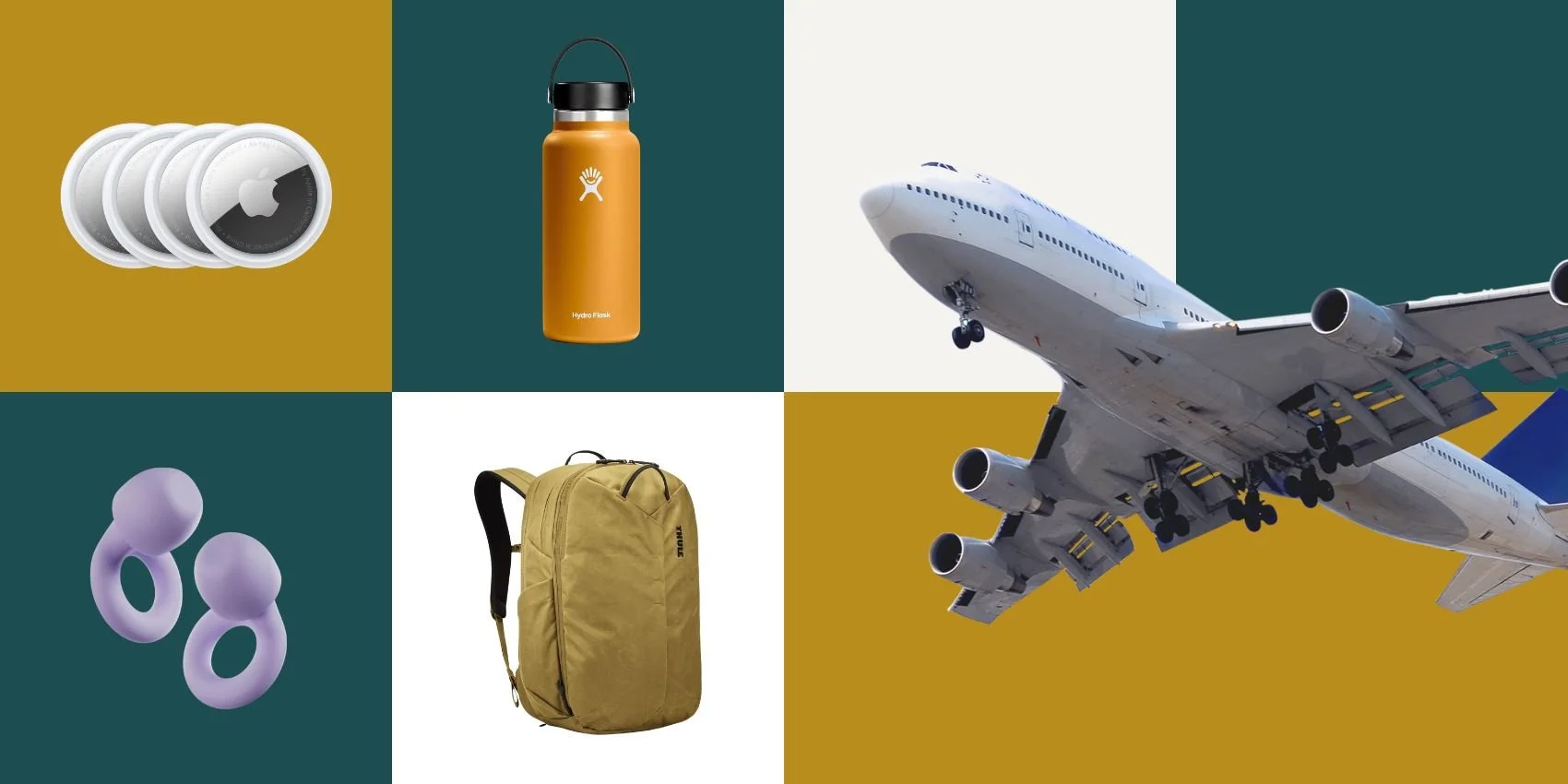
For gear: Bose headphones and Airpods (both, because they each have their time and place, and I am not leaving this to chance on a long flight), a battery pack (or two) with built-in charging cords, a Sandcloud towel, a neck pillow clipped to the outside of my backpack so it doesn’t take up extra space, an eye mask, ear plugs, a filtered water bottle or Hydroflask, and an Airfly if you want to use your own headphones with the plane's entertainment system. Most of this lives on my Carry-On Edit list if you want to see it all in one place.
I wear compression socks on every flight longer than three hours. I have Raynaud's and poor circulation, and one trip to Costa Rica with swollen feet that ruined my first few days of the trip was enough to teach me. I’ve seen it happen time and time again with travelers on my group trips. We aren't 20 anymore. Just wear them.
Snacks. Always snacks. Airport food is overpriced and disappointing, and I refuse to pay $20 for a sad sandwich because I didn't plan ahead. My current rotation:
For meds, I pack whatever I might need on the plane for headaches, stomach issues, and sleep, plus any prescriptions. I never take a chance on prescriptions getting lost with your checked luggage. I love this travel pill container that fits easily in my carry-on without bringing entire bottles, and I refill it after every trip.
As an Amazon Associate I earn from qualifying purchases.
Lip balm always, because planes are basically flying deserts.
For my airport outfit: a soft sweatshirt, Lululemon dupe leggings, and Allbirds sneakers. I usually wear the sneakers barefoot and put compression socks on right before boarding. I
love a one-piece for ease and comfort, but bathroom logistics in airports and plane bathrooms make it a hard no, so I suggest saving your jumpsuits for the trip itself.
I wear my heaviest jacket or bulkiest item on my body to save luggage space, and if I'm traveling with a large hat, I clip a hat holder to the outside of my backpack instead of cramming it in and destroying it.
Anything valuable — laptop, camera, drone, important documents — stays on my body or in my carry-on. Never checked, and no batteries are allowed in checked bags either.
Keep an extra outfit, underwear, and pair of shoes in your carry-on in case your checked bag gets lost. Travel disasters happen more often than you'd think (and if you don’t believe me, you can read all about it here).
And before you consider yourself fully packed and done, invest in a luggage scale, and weigh your luggage. All of it. Make sure to bring it with you because if you’re like me, your luggage gets heavier on the way home once you fill it with international treasures. Don’t find out at 4 am with the world’s biggest hangover in the Athens airport that your bag is overweight and you need to pay an extra 150 euros. I promise it’s the best $10 you’ll ever spend.
Before the Flight
AirTag everything.
I’m going to say that again—AirTag everything.
Even if your airline has luggage tracking (many international airlines do not), it’s worth the peace of mind knowing where your bag is at all times. I have approximately one billion stories of an AirTag saving the day for me or one of my travelers, but the best one goes like this: a woman accidentally stole my suitcase off the baggage claim at O'Hare (ours were almost identical), and I stood there watching my bag drive down the interstate in real time on the FindMy app.
The full story deserves its own post, but the TLDR version: that one little AirTag is the reason I ever saw that suitcase again.
While we're on the subject, put something identifying on your bag so nobody can mistake it for theirs. A bandana. A hot pink luggage strap. A large sticker of your own face. The more obnoxious, the better — and this goes double if you own the standard black suitcase that looks like every other bag on the carousel (ask me how I know).
Charge every electronic the night before, so you're not the person crouched next to a pillar at the gate fighting a stranger for an outlet or finding out after you get on the plane that the outlets don’t work (spoiler alert, they often don’t).
Download everything you need — for the flight AND for wherever you're going. A lot of countries have spotty internet, and the second you board the plane, your signal is often gone. That’s usually the moment I realize I didn’t download things ahead of time. Do it at home, on your own wifi, like a person with a plan.
Make sure your eSIM is downloaded and ready so you have data the moment you land—you don’t want to be researching this on international roaming after you arrive. Just make sure you keep your phone on airplane mode until you land, and switch your eSIM on and your regular cell service off before you turn airplane mode off. The briefest moment of your phone connecting to your regular number in a foreign country can still accrue a daily charge.
Know your layover details, your flight times, and your plan for when you land. After a 14-hour flight, everything is disorienting — especially arriving in the middle of the night. And if you drove to the airport, put your keys somewhere specific in your bag that you won't touch for the entire trip and take a photo of where you parked. Future you, jet-lagged and standing in a parking ramp where every floor looks identical, will be so grateful.
Empty your water bottle before security (I make this mistake constantly, and it’s the most obvious one). Fun fact: you can actually bring ice in a water bottle through TSA, as long as it’s frozen solid when you go through screening—just don’t be surprised if they give it a second look, which might take extra time if you’re in a hurry.
And my biggest tip (and even more important for frequent travelers like me who don’t think twice about packing): double-check your carry-on for things that'll get flagged, like knives, sharp objects, wine key, and batteries. It sounds silly, but things get moved around while you travel, and you may forget you left a wine key in your backpack while you were on your trip. Also check toiletries — anything over 3.4 oz needs to go in your checked bag. European airports in particular will randomly hand you a quart-sized ziplock like it's 2002 and throw away whatever doesn't fit — yes, even that fancy body wash you bought in France. It’s happened to me many times—every airport has its own rules, and they aren’t going to argue with you. Don't learn this at the security line.
At the Gate
Use the bathroom before boarding. Every time.
Put on your compression socks while you're still sitting at the gate — much less acrobatic than attempting it in seat 34C with the person next to you watching.
Apply extra lotion. See above re: flying deserts.
Figure out the wifi situation before takeoff. Some planes have free wifi if you download an app or create an account first, so do it before you're in the air with no signal.
Then mentally organize your personal item: what do you need for the flight versus what can live in the overhead bin? My goal is to never have to get up to get anything unless I want to. Everything I need goes into the smaller Osprey bag; my backpack goes in the overhead bin if there’s extra space or I don’t have a full-sized carry-on. And if you have a purse and you're worried about exceeding your carry-on allowance, put it inside your backpack before boarding. Airlines have moods about this, and it depends entirely on the day.
On the Plane
Put your bag above and move out of the aisle immediately so the 147 people behind you can get to their seats. If you need more time, move into your seat and let people pass so you don’t feel rushed, and then proceed. The anxiety from this moment alone is what has made me an aisle seat girly, through and through.
Get situated: Small Osprey bag, water bottle, and neck pillow at your feet. Passport goes somewhere you know and won't forget, not the seat pocket. Get your pillow and blanket out, put your headphones on, prep for any meds that should be timed around meal service, and start a movie, read a book, or listen to music. Make sure your seatbelt is on, tray table is put away, and your seat back isn’t reclined so the flight attendants don’t have a reason to disturb you.
Put your phone on airplane mode. If traveling internationally outside Mexico or Canada, this is when you can turn off cellular data on your regular line and switch to your eSIM (as long as airplane mode is on).
If using your phone in flight, make sure it’s charged for landing so you aren’t left with a dead phone upon arrival when you need an Uber.
Now is when you try to enjoy your flight because you’ve fully prepared yourself for it. The routine isn't the goal; the calm is.
Before Landing
Pack up your belongings during descent, so you're not that person still digging through the overhead bin while everyone waits. Know where your passport is before the wheels touch down. Upon landing, turn on your eSIM, take your phone off airplane mode, and review your plan for getting from the airport to your accommodation.
I know the return home is its own beast, and I wrote about surviving post-vacation re-entry if you're in that particular fog.
Long-Haul Flight Questions I Actually Get Asked
How early do you get to the airport for an international flight?
It depends on where I am and which airport I’m flying out of. Generally, 2 to 3 hours is standard, but it also depends on whether you’re checking a bag, what time of year you’re traveling, and how well you know the airport. When in doubt, go early. It’s not worth the stress.
Which eSIM do you use, and when do you set it up?
I use GigSky, and I set it up a few days before I leave so it’s ready the moment I land. Use code LAURAE10 for 10% off your first data purchase.
Can you bring a power bank on a plane?
Yes, but only in your carry-on, and never in a checked bag. Power banks up to 100 Wh are fine, anything between 100 and 160 Wh needs airline approval, and anything bigger stays home. As of 2026, a lot of airlines also cap you at two power banks (some at one), and several international airlines don’t let you use them during the flight or keep them in overhead bin. The rules are constantly changing, so check your airline’s specific rules before you go.
Do you need travel insurance if your bag gets lost?
I always recommend traveling with travel insurance, period. I’ve seen so many things go wrong, and so many people have had to use it, including myself. You never know when your bag is going to go missing, and even if it’s only gone for a day, it’s inconvenient. If you need a place to start, I recommend Wanderwell, and Episode 9 of the podcast breaks down how travel insurance works.
If Your Airport Routine Is Currently "Panic"
Maybe you have PTSD from repacking your suitcase at the check-in counter while the line watches (been there). Or, maybe you haven't flown internationally in years, and it feels like the rules changed while you weren't looking (sorry to say, but they probably did).
Maybe you're fine at the airport, but the second you land somewhere unfamiliar in the middle of the night, your brain turns to static.
I see you, and none of that means you're bad at travel. It means nobody ever handed you the routine. Now you have it.
Most of this becomes automatic after a few trips, but if you'd rather your first few trips are with someone who's already thought of everything past the jet bridge, that's literally my job. On our group trips, the flight is the only part you handle solo. You show up, and we handle the rest.
Want to go deeper on the prepared-not-paranoid traveler mindset? I talked with travel risk expert Casey Hanisko about exactly that on Episode 8 of the Type 2 Travel Podcast.