
Wine, Sulfur Baths and a Whole Lot of Toasts: A Georgia Recap
Guest post written by Mel Ripp
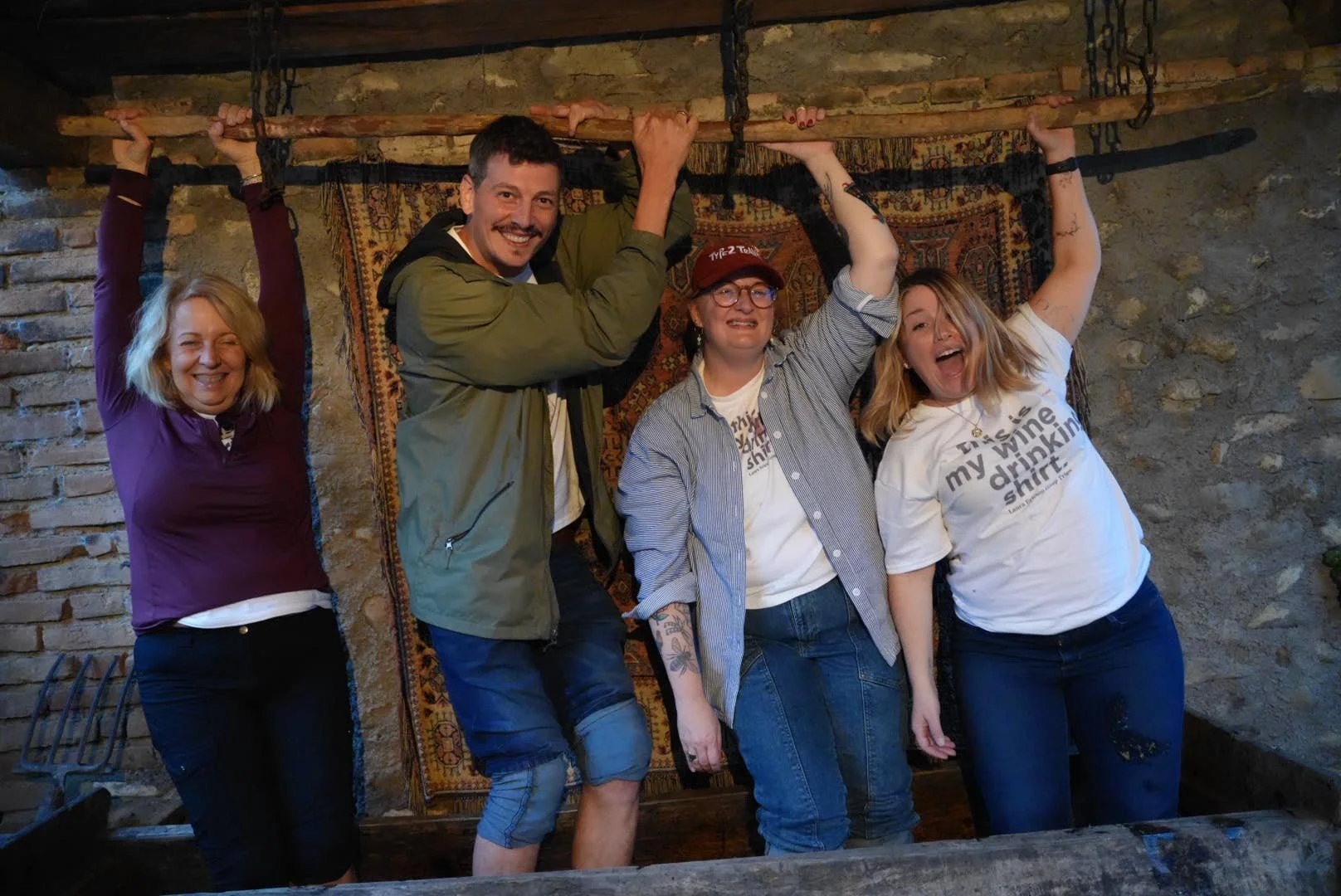
Stomping grapes at a wine harvest in the Georgian countryside
This post may contain affiliate links from which we may earn commission from qualifying purchases at no cost to you.
Somewhere in the middle of our first Georgian supra, I had two simultaneous thoughts:
Will we EVER be done with this dinner?
We had toasted—with full glasses of wine, mind you—so many times that I was convinced we were all just going to live there now.
Do I ever WANT to be done with this dinner? Can I just live here now?
Ah, the Georgian supra. A traditional feast that goes on for hours longer than any fancy coursed dinner you’ve ever had. The table keeps filling up—with food, with wine, with dancing and music, with conversation. A toastmaster (called the tamada) leads a collection of toasts to everything from your ancestors to peace to the people sitting next to you.
Did I mention there’s a full glass of wine for every one of these toasts? Oh, right—I did.
(I think my body and my brain are still recovering from this trip.)
The supra I’m talking about was in Kakheti. By then, our group had been in Georgia for four days—and the country had already been working its magic on us.
Let’s wind it back, because I want to talk about everything. The combination of the “aggressive hospitality” of the Georgian people (more on that below), its distinct culture (right at the crossroads of Eastern Europe and Western Asia), and the tradition of winemaking and food set a bar I’m not sure another country can clear.
Every trip after this one is going to be compared to it, and I already feel a little bad for whichever country comes next (sorry, Colombia). 😂
This is my recap of Type 2 Travel’s 10-day group trip to Georgia (the country, not the state) in October 2026, led by Laura Ericson: three days in Tbilisi, a grape harvest in Kakheti wine country, abandoned Soviet spas near Kutaisi, two nights in a hotel inside Rabati Fortress, and three full-blown supras.
But First, Some Real Talk About Georgian Wine Culture
Georgia has been making wine for about 8,000 years, and the way people drink it there is nothing like the way we drink it back home.
Everyone in our group had managed to fly into Tbilisi early, which meant we were able to get a little additional exploring in before our group dinner that evening at our hotel.
And of course, within ten minutes of walking around, we found ourselves at a wine store, for a wine tasting, natch.
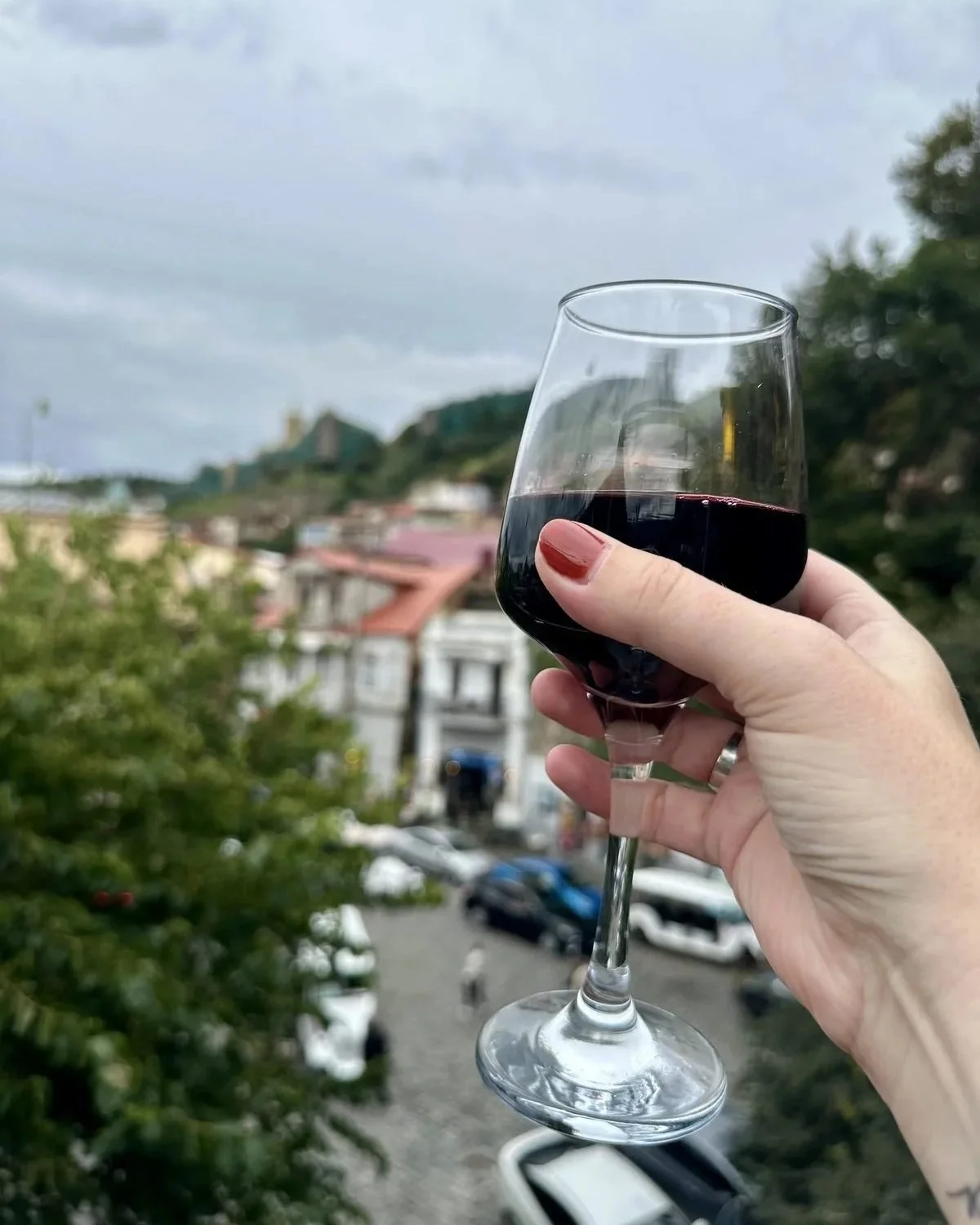
Enjoying a glass of Georgian red over the Tbilisi rooftops, about ten minutes into the trip.
Now, before I go any further, I need to tell you about Georgian wine culture.
This isn’t a drinking culture. I’m from Wisconsin, and I know a drinking culture when I see one. In our state, drinking is usually the point—for better or worse. In Georgia, wine is part of everything else: the meal, the toasts, the family and the history.
And it’s a long history. Georgia is the oldest confirmed birthplace of wine, with evidence of winemaking that goes back about 8,000 years. The country has more than 525 native grape varieties. At the shop, we tasted a half dozen of them, and I’d never heard of a single one before that afternoon. My early favorite: Saperavi, the deep, full-bodied red that tasted like a Malbec, but better.
What surprised me the most was the color of many of the white wines. Traditional Georgian whites like Rkatsiteli are fermented with the grape skins and seeds still in, so they come out amber instead of pale yellow, with much more body than any white I’d had at home.
A lot of that wine is still made the old way, in clay vessels called qvevri, and the method is so tied to Georgian identity that UNESCO lists it as part of the world’s cultural heritage. Many families still make their own wine and keep it in a home cellar called a marani. That’s why, when a Georgian pours you a glass, it isn’t just a drink. It’s often something their family made, and they’re sharing it with you.
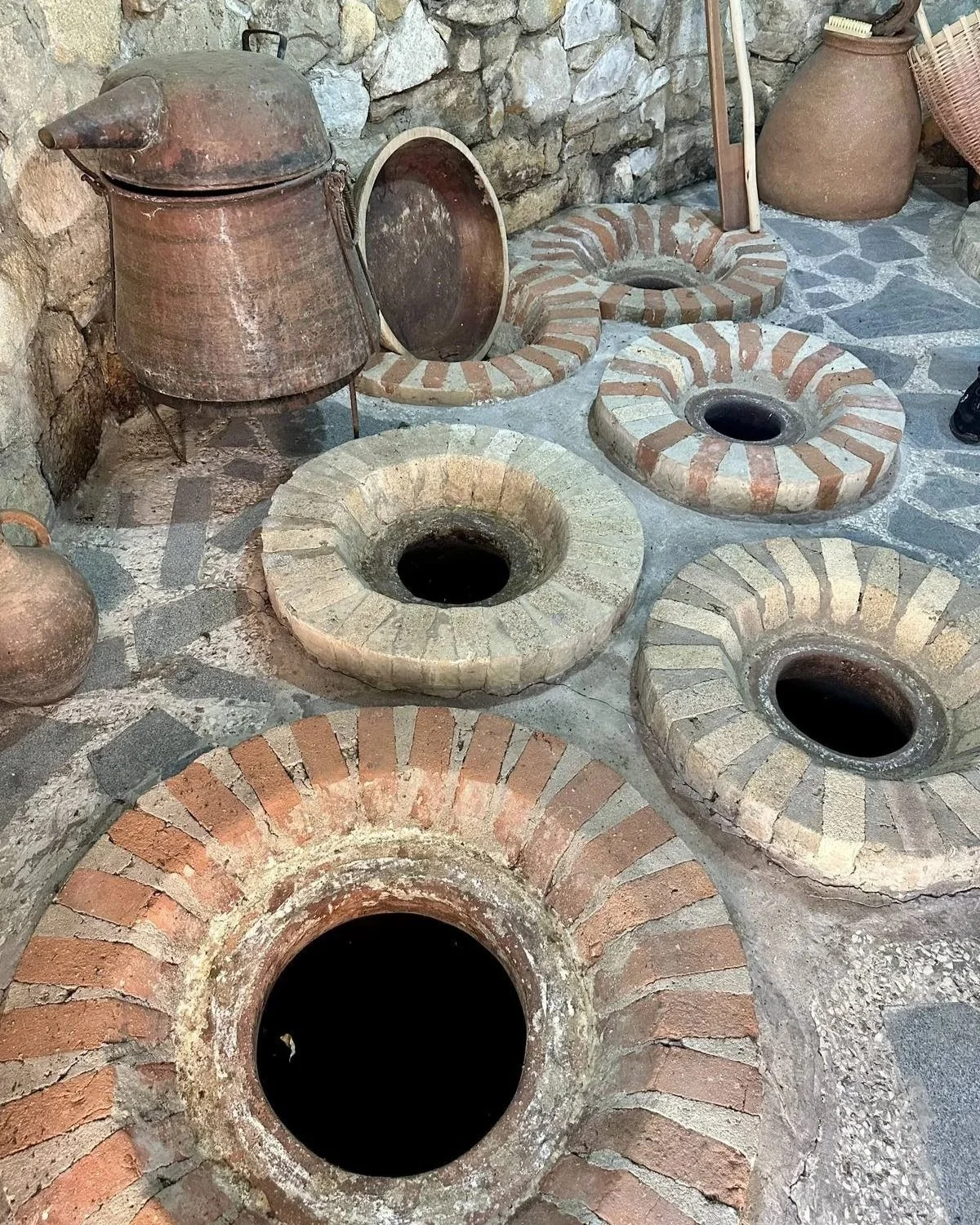
Qvevri buried up to their necks, the way Georgians have made wine for thousands of years.
So yes, we drank plenty of wine on this trip. It just meant something different there.
Tbilisi, or Everyone Into the Sulfur Bath
Tbilisi, Georgia’s capital, gave us sulfur baths, a walking tour of the Old Town, and golden hour at Jvari Monastery.
The wine store kicked off three days in Tbilisi that were whirlwind-y in the best possible way.
It took me about one walk around the block to realize Tbilisi doesn’t look like any other city I’ve visited. The city is built into the hills on both sides of a river. Old brick houses with carved wooden balconies are stacked up the slopes, and an ancient fortress looks down on them, with domed bathhouses, church spires and a mosque all within a few minutes’ walk. Then, right in the middle of it, there’s a curvy glass bridge or a Soviet-era apartment block. It’s a city that feels like several centuries and a few empires all decided to live on the same street.
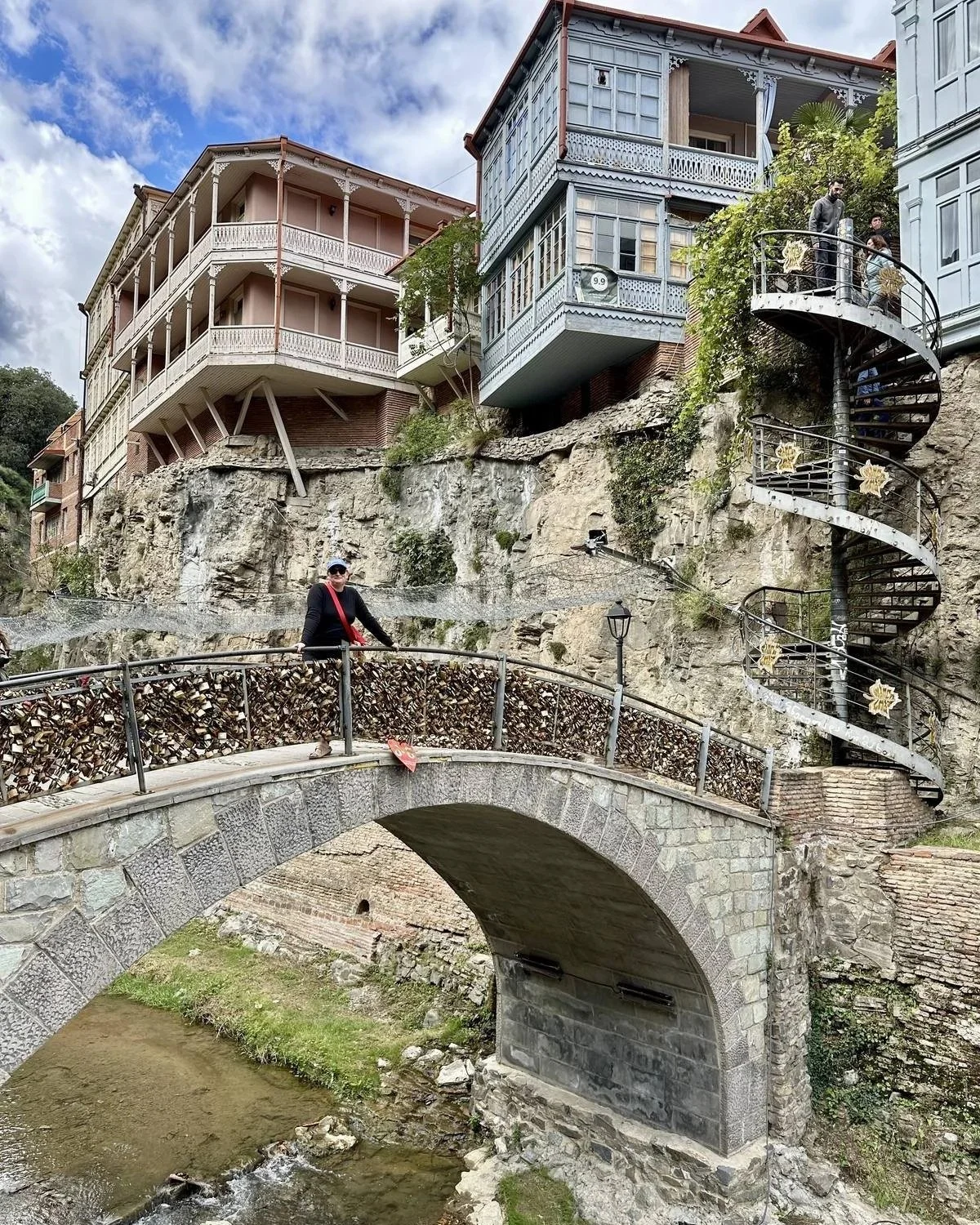
Old Tbilisi’s carved wooden balconies, stacked right up the cliff.
Our first full day started with free time in the morning and afternoon to wander (which I spent taking a cab to a vintage store and walking to Dry Bridge Market to buy ALL the art) before we walked over to the Orbeliani sulfur baths, one of the most recognizable bathhouses in the city. The natural hot springs (around 100–114°F) are what gave the city its name (“tbili” means “warm” in Georgian).
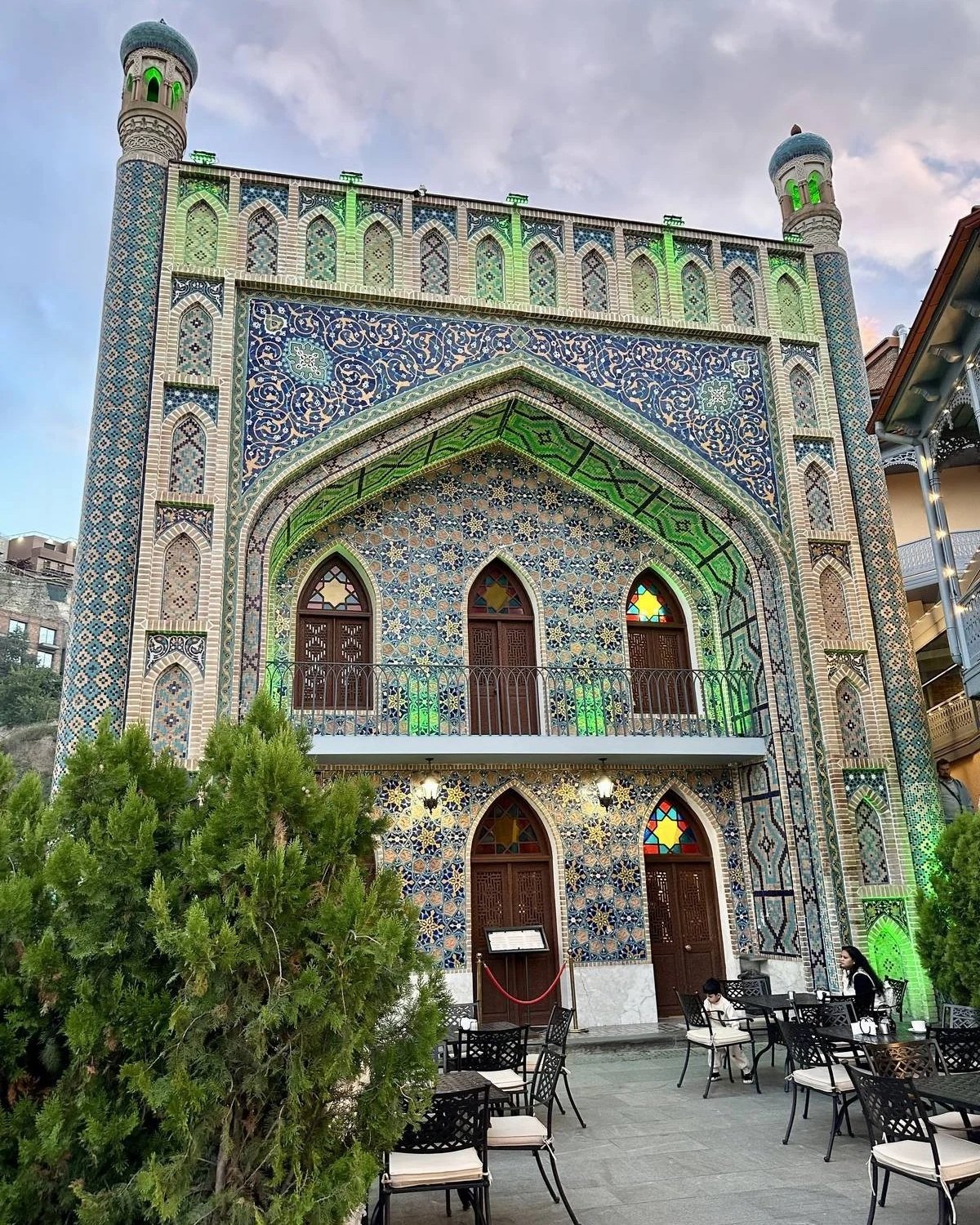
The tiled front of the Orbeliani baths, where we spent a few very restorative hours.
We spent a few restorative hours in the bathhouse (nothing brings a group close like sulfur baths!) before heading to dinner, where more Georgian wine awaited us (I know, shocker) and plenty of food (this also will become a recurring theme).
On our second full day, we met our incredible Georgian guide, Giorgi, who would be with us for the rest of the trip. He took us on a walking tour of Old Tbilisi, starting in the bath district we’d soaked in the day before and winding through the Meidan Bazaar, past the Juma Mosque and up to Metekhi Church on the cliff above the river. He also showed us the spots we never would have found on our own, like the waterways behind the sulfur baths and even a waterfall in the middle of the city.
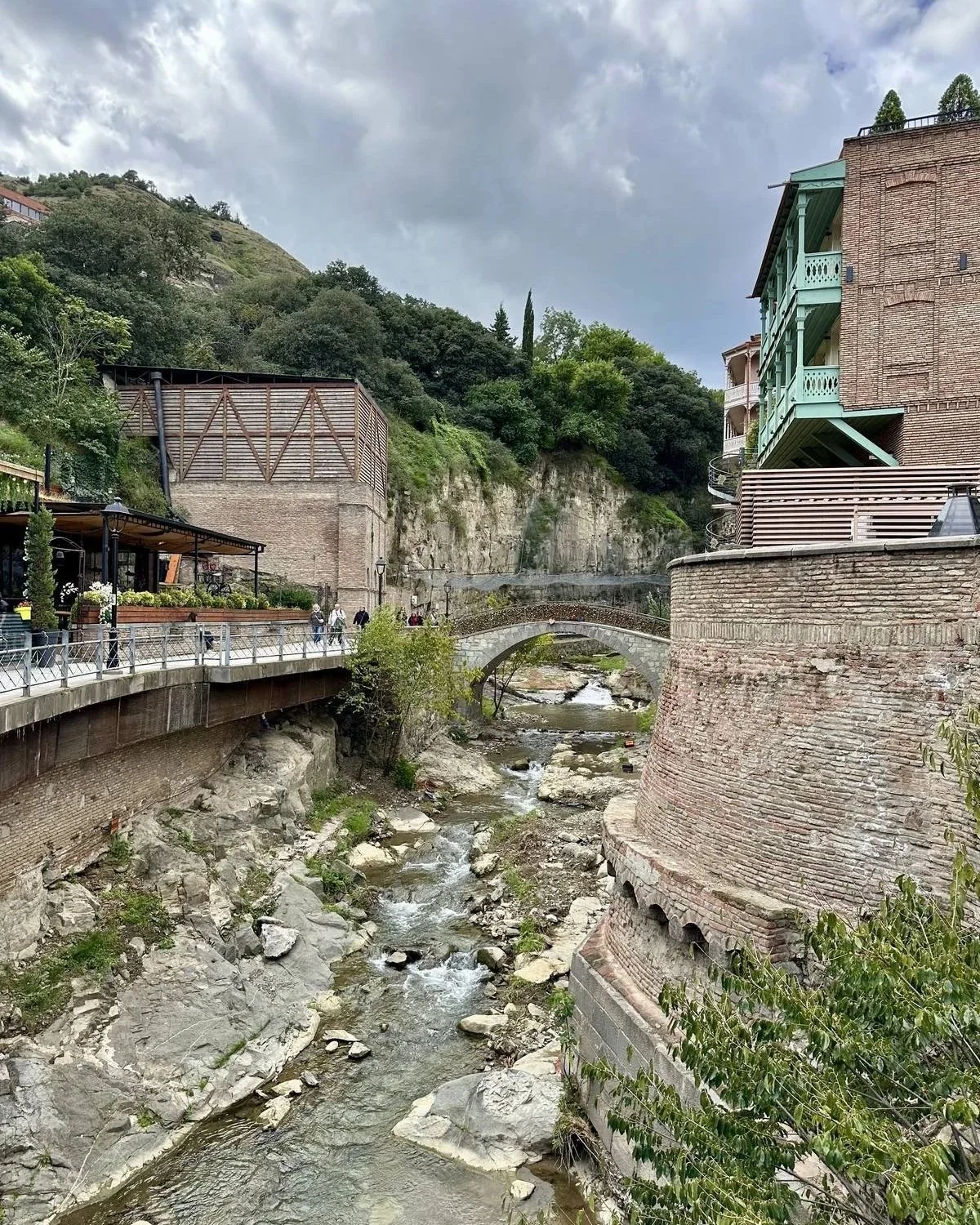
The gorge behind the bath district, hiding in plain sight in the middle of the city.
After lunch and a little free time, we drove out to Jvari Monastery, where Christianity took hold in Georgia back in the 300s. It sits on a hilltop where two rivers meet, and we got there right at golden hour.
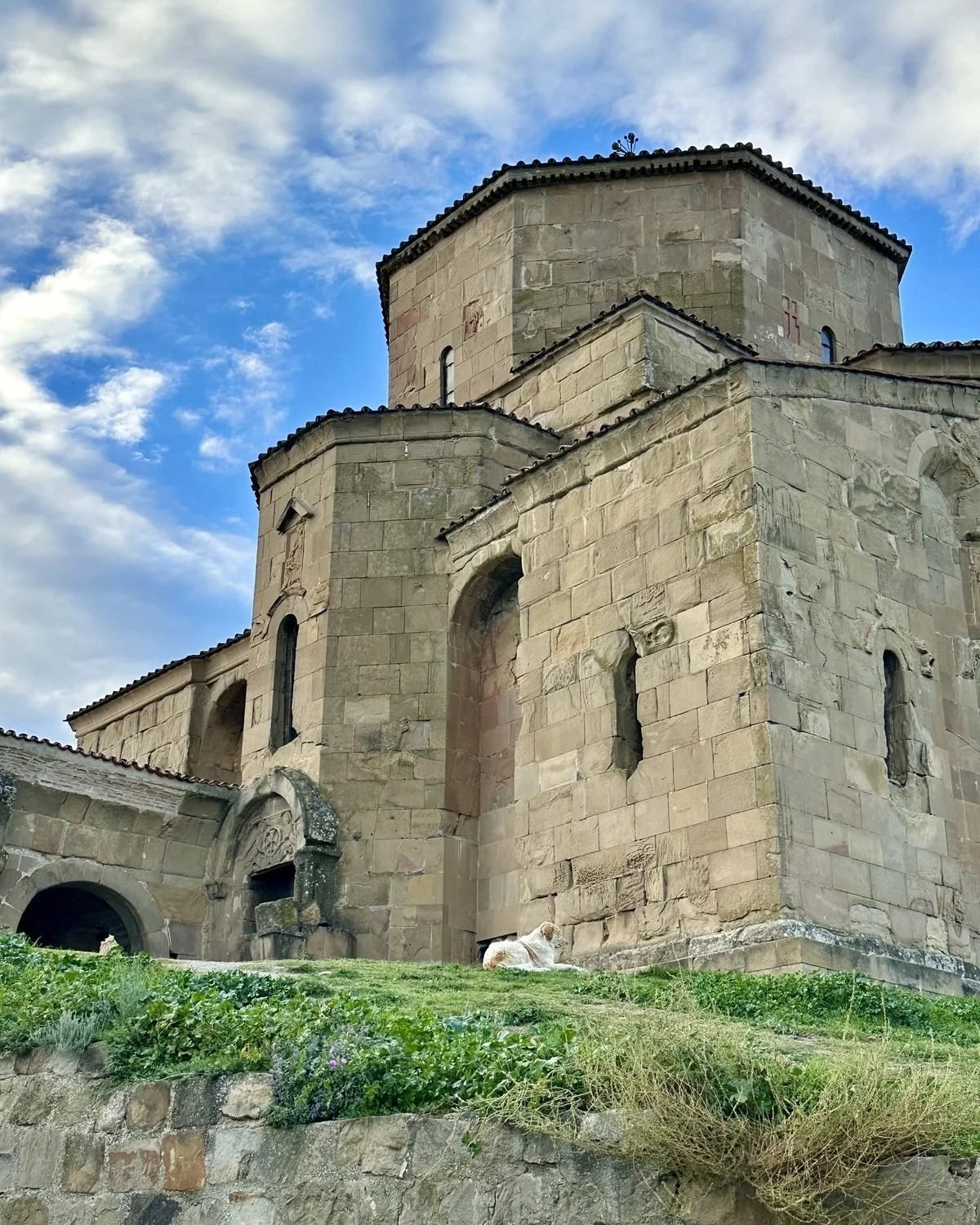
Jvari Monastery, up on the hilltop where two rivers meet.
From there, we headed down to Mtskheta, Georgia’s ancient capital, to see its centuries-old cathedral and wander the cobblestone streets as the sun went down.
We ended the night at a traditional Georgian dinner with a live dance show, and had our first taste of khachapuri—the national dish of Georgia: a warm, yeast-risen bread stuffed with melty cheese.
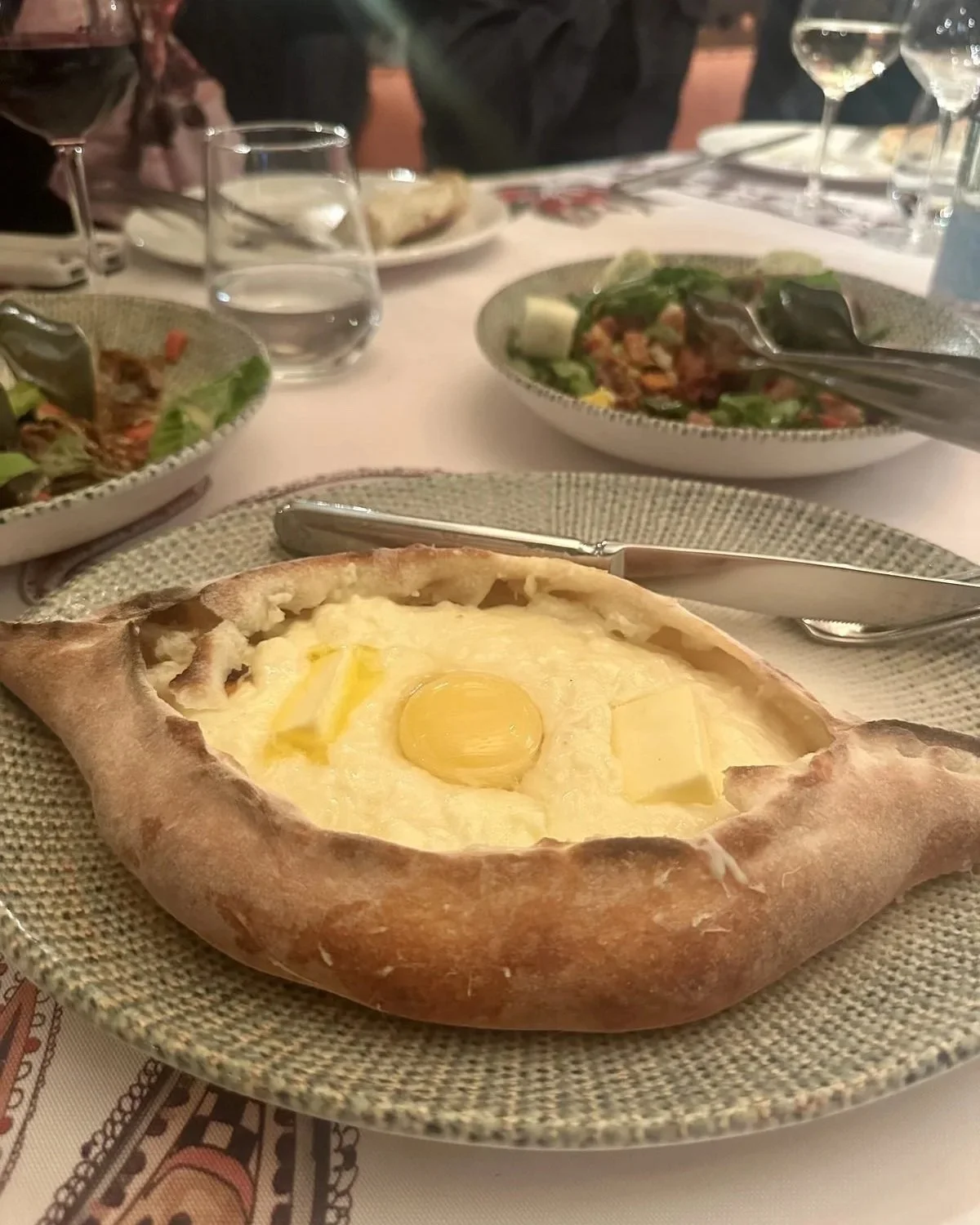
Khachapuri: bread, cheese, butter and an egg. I have no notes.
Kakheti Grape Harvest, or That Time I Drank Wine Off a Roof Tile
Kakheti is Georgia’s main wine region, and our one day there packed in a winery lunch, a zipline into Sighnaghi, a family grape harvest and our first supra.
The next morning, we packed up and headed east to wine country, where it turned out the wine shop had just been a warm-up.
Our first stop was a wine tasting and tour at Giuaani Winery, where we saw our first real qvevri. These are huge, egg-shaped clay jars, some big enough to fit a person inside, that are buried up to their necks in the ground. The grapes go in with their skins and seeds, and the jars are sealed and left underground for months while the earth keeps the temperature steady.
In addition to the wines, Giuaani also had…cats. Cats…which kept me occupied and made it hard to keep up during the toast portion of the lunch.
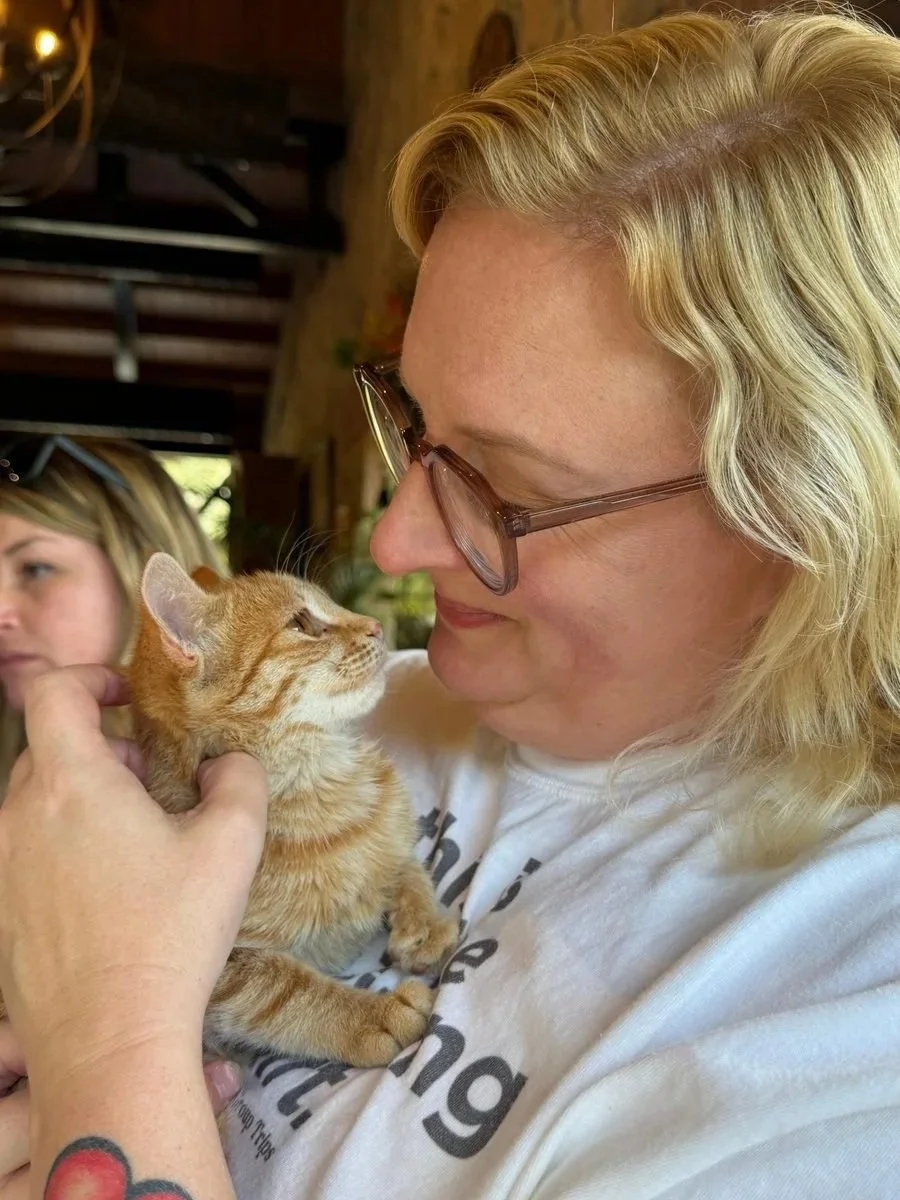
One of the Giuaani cats, a.k.a. the reason the toasts got away from me.
From there, it was a drive to a viewpoint over Sighnaghi, a little hilltop town surrounded by old fortress walls.
How did we get from the viewpoint to the town, you ask? Oh, we ziplined. No big deal. My first zipline, and let’s just say I’m glad I had a few glasses of wine to calm my nerves beforehand.
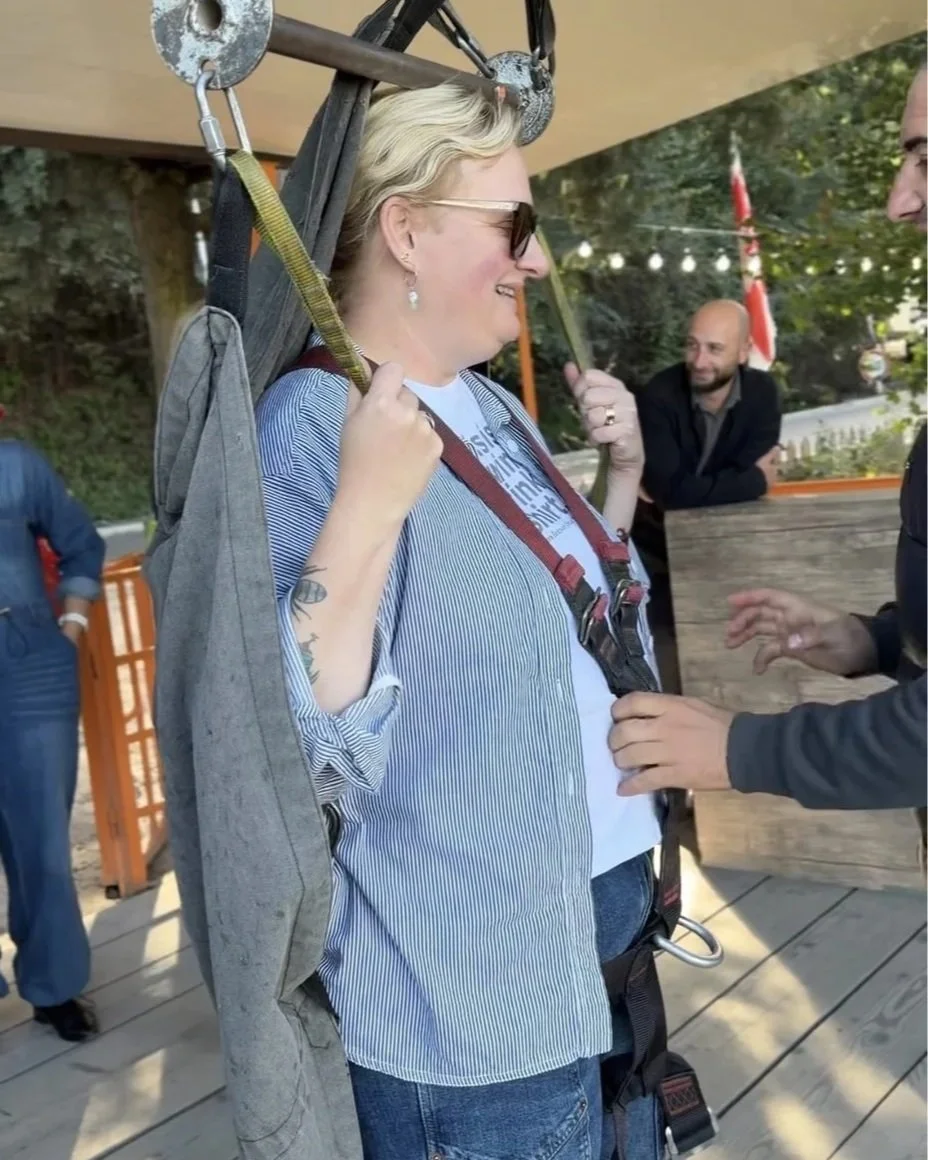
The zipline into Sighnaghi, and the reason we had wine first.
Then came the part of the trip I’d been most excited about: the wine harvest. We spent the afternoon with a local winemaking family, and they put us straight to work. We picked grapes, and then we took off our shoes and stomped them the old-fashioned way while musicians played Georgian folk songs. We also contributed to that night’s supra by learning how to make khinkali—the delicious Georgian soup dumpling—which are MUCH harder to fold than they look!
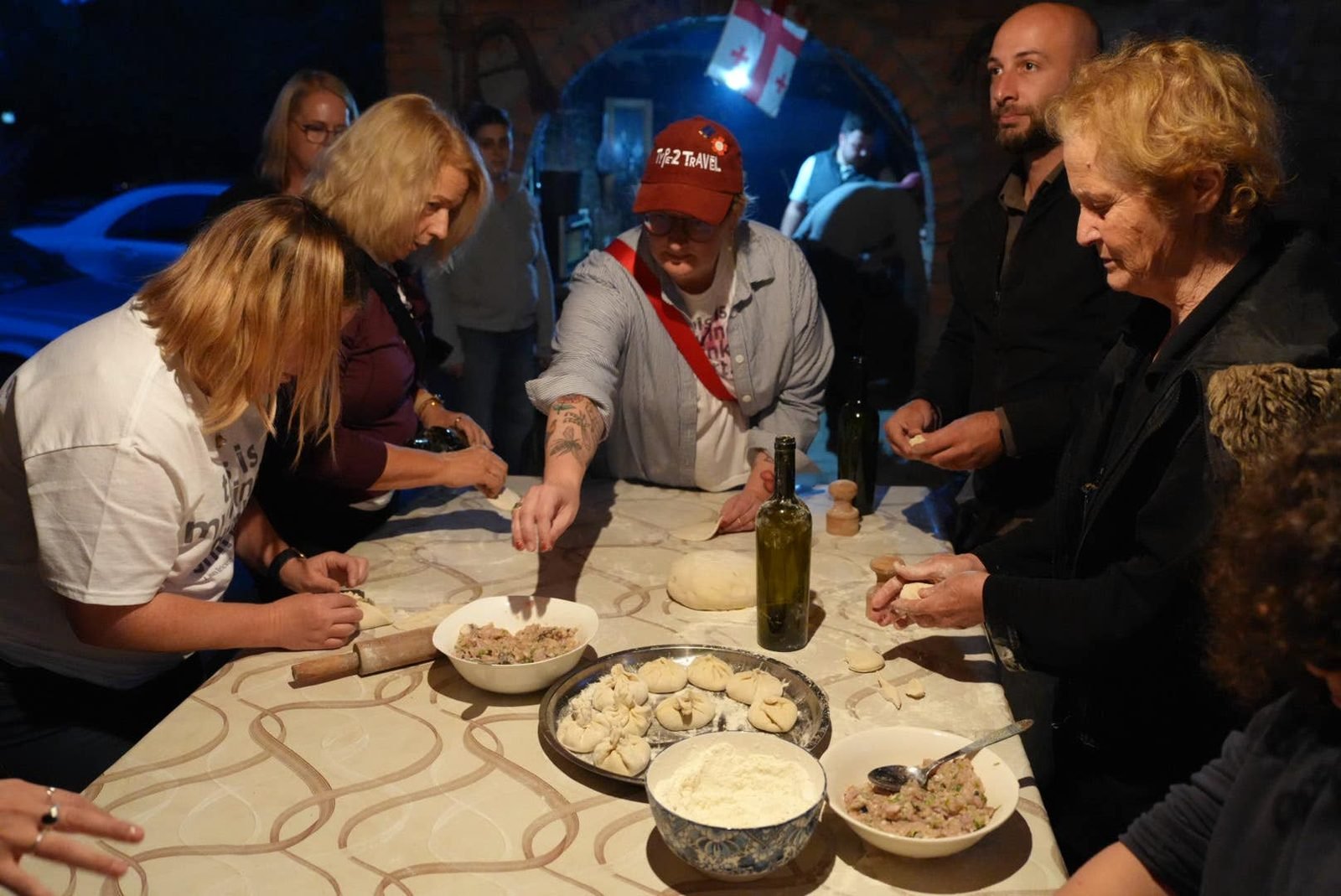
Our group folding khinkali for the supra. They’re harder than they look, I promise.
And then the sun went down and the supra began, which is where this whole story started. Four hours, dozens of khinkali, and roughly 30 toasts later—one of which I did while shotgunning wine from a clay roof tile—we were on our way back to the hotel.
A Quick Aside About Georgian Hospitality
Earlier in this post, I talked about the “aggressive hospitality” of the Georgian people. This isn’t aggressive in a bad way—it’s relentlessly kind and warm. In Georgia, hospitality and hosting people is literally viewed as a sacred cultural duty. They sum it up by saying “a guest is a gift from God.”
The supras are the best example of that. The meals are long and abundant. There’s often more food left at the end of the feasts than at the beginning. The reason is simple: Georgians don’t want their time with you to end.
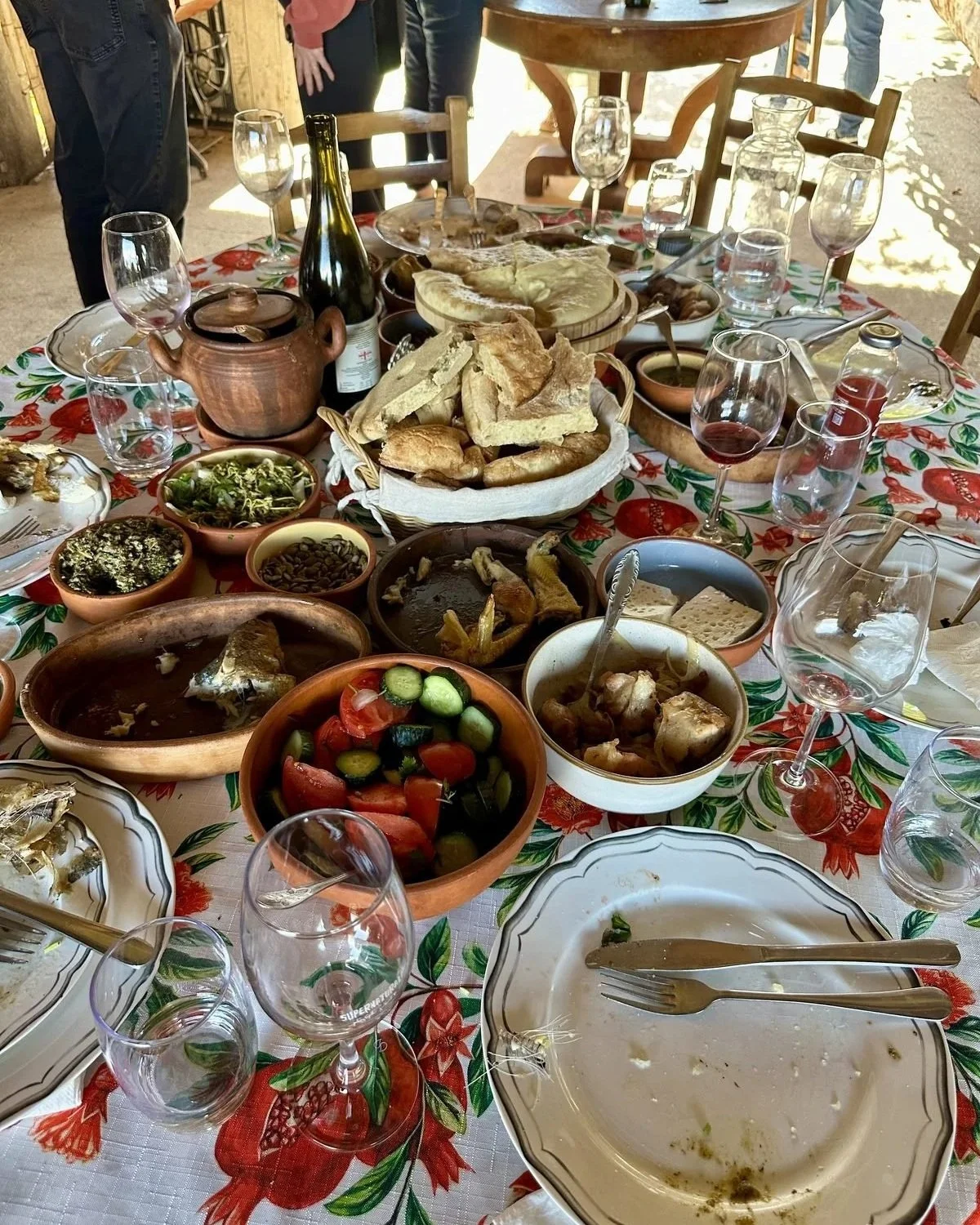
A supra table, already full, with more on the way. There’s always more on the way.
Kutaisi, or Wine in a Cave and Ghosts in a Spa Town
The drive west to Kutaisi took us through a Tushetian village, and the next day brought abandoned Soviet spas in Tskaltubo and a wine tasting in a cave.
After the supra the night before, we needed a slow morning, and we got one. Then we loaded up our luggage and said goodbye to Kakheti, with a few more stops on the way out.
The first was Alaverdi Monastery, a fortified monastery with the Caucasus Mountains behind it, where the monks have been making wine in the same spot since 1011. From there, we stopped in Kvemo Alvani, a small village settled by Tushetians, a community that came down from the mountains of northeastern Georgia.
We visited a wool workshop, got to try our hand at wool needle felting, and had a Tushetian lunch on the terrace with mountain tea and our host Vakho’s delicious homebrewed beer. Then came the drive west. We rolled into Kutaisi that evening and had the night to ourselves.
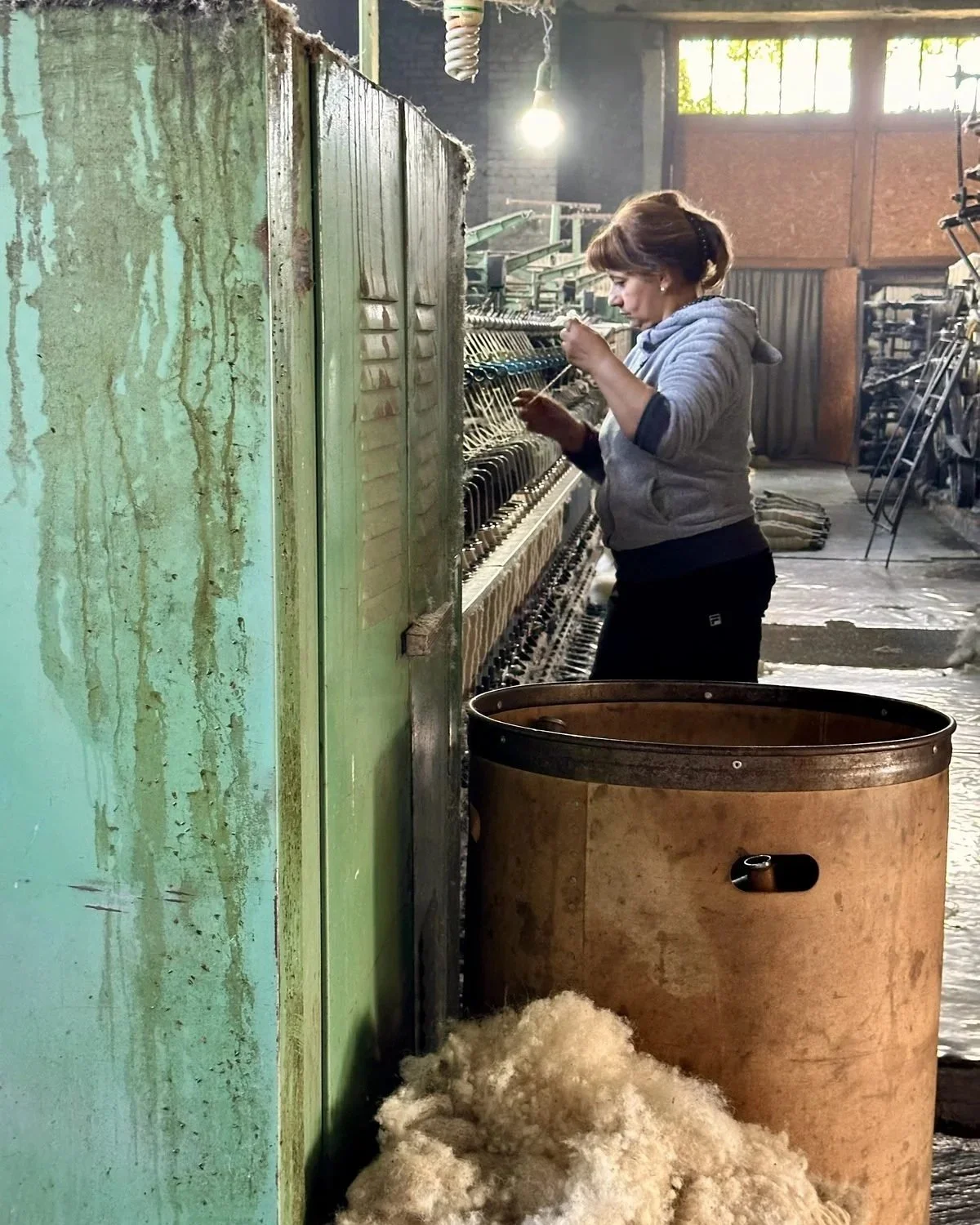
Inside the wool workshop in Kvemo Alvani, before we tried our own (much clumsier) hand at felting.
The next morning we were free to explore Kutaisi, one of Georgia’s oldest cities. Highlights for me included the Colchis Fountain in the middle of the main roundabout of the city’s center, and the central market, which sold everything from spices to produce to tennis shoes to wine in VERY large plastic bottles.
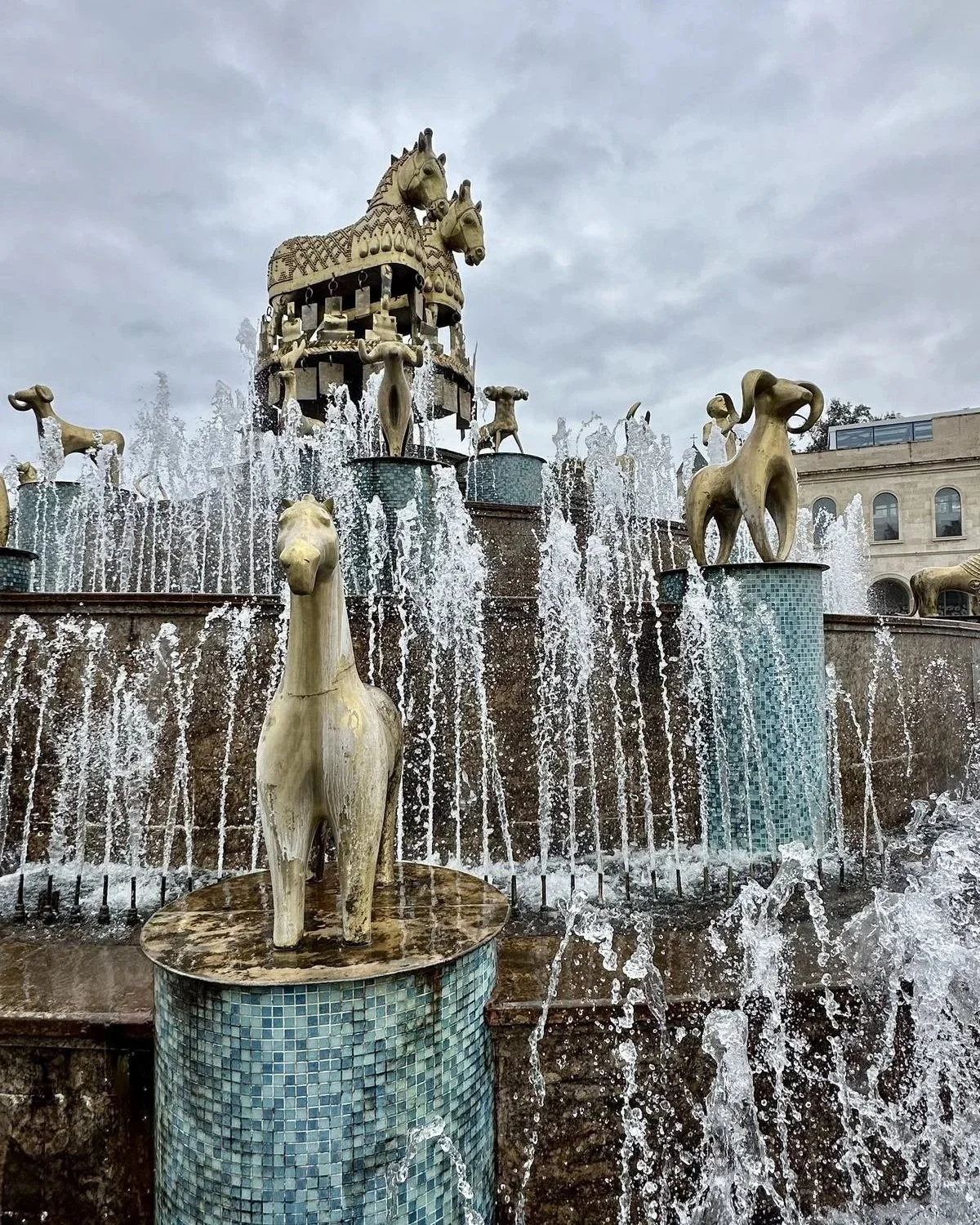
The Colchis Fountain, right in the middle of Kutaisi’s main roundabout.
In the afternoon, we drove out to Tskaltubo, a spa town that was once a retreat for Soviet officials and workers. Today, most of its grand sanatoriums are abandoned. We explored them with a local guide, walking past crumbling columns and empty pools, with plants growing up through the floors. It was a little eerie, but so cool.
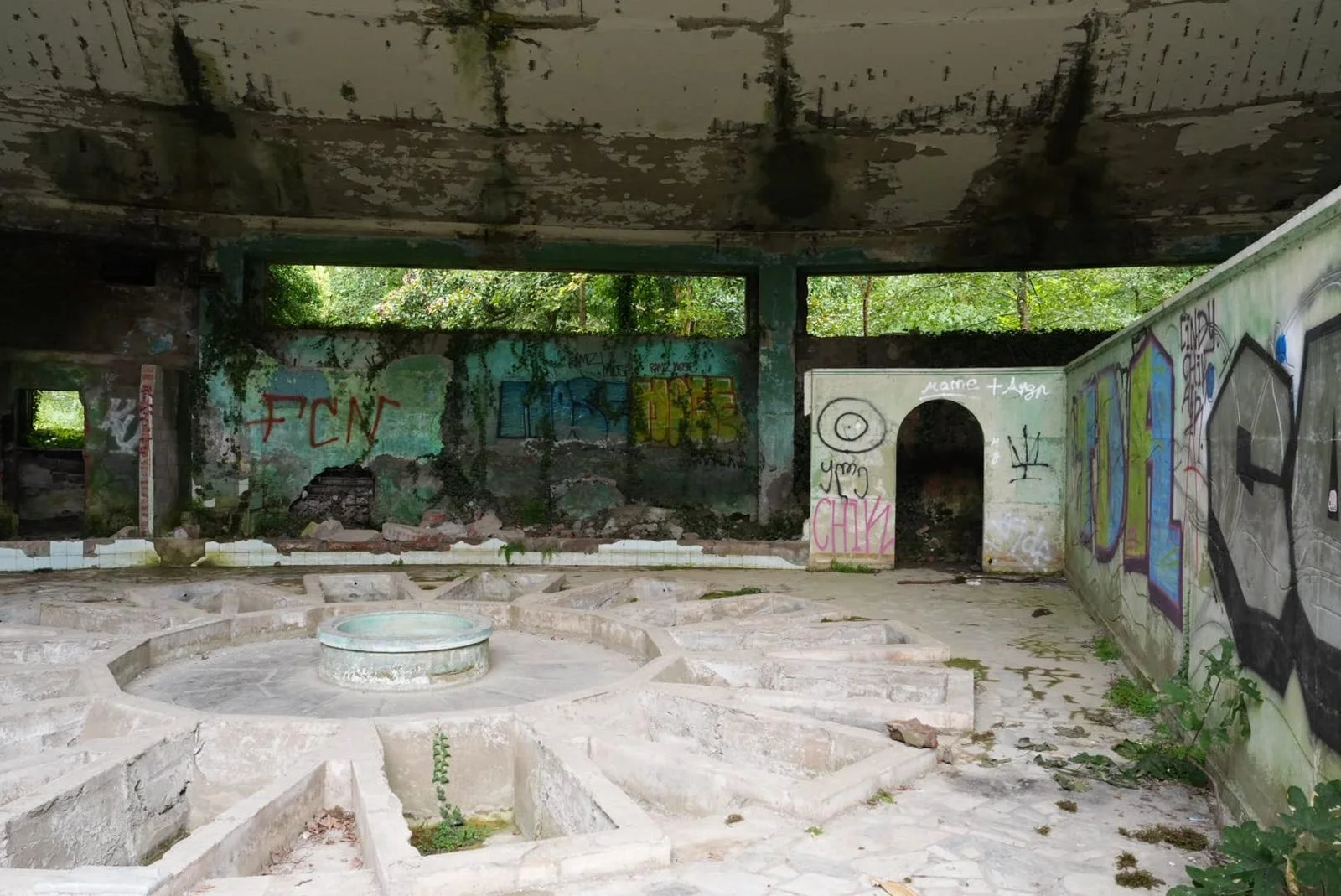
An empty pool in one of Tskaltubo’s abandoned Soviet sanatoriums.
Then, because this is Georgia, we went to a wine tasting in a cave before ending the evening at Korena’s, a family-run guesthouse where we had dinner with a view of Gelati Monastery at sunset. Giorgi warned us that “there will be a lot of food at this one,” and yep—he was right. Again.
Rabati, or Our Hotel Was a Fortress (No, Really)
Rabati is a medieval fortress in the town of Akhaltsikhe in southwestern Georgia, and yes, our hotel was inside its walls.
We left Kutaisi early with all our luggage, and the drive turned out to be one of the best days of sightseeing on the whole trip.
Our first stop was Katskhi Pillar, a natural stone column about 130 feet tall with a small monastery perched on top. I had seen photos of the Pillar prior to the trip and was completely convinced this was fake. How could a column like this exist in real life?
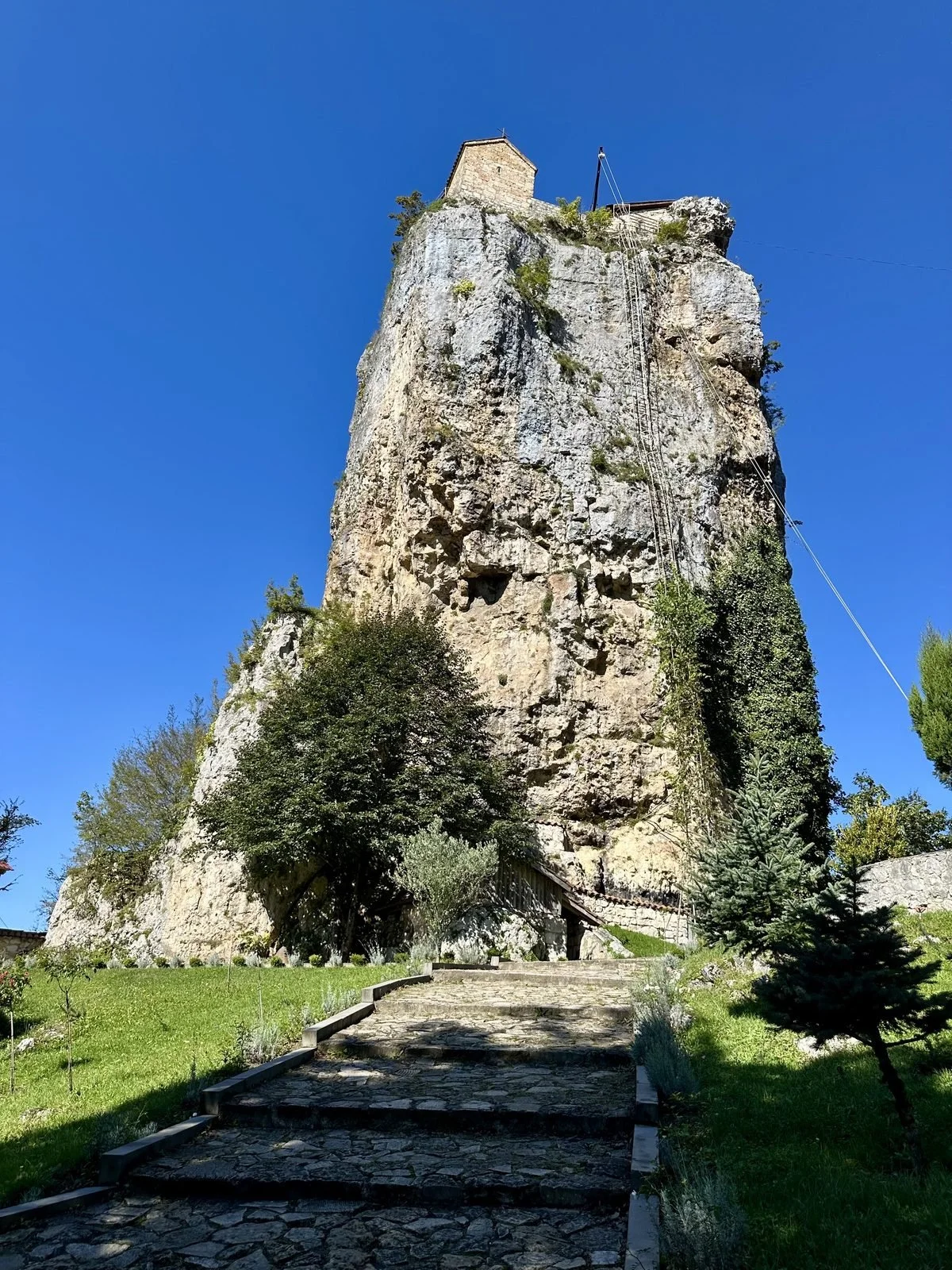
Katskhi Pillar. I’ve seen it with my own eyes, and I’m still not totally convinced it’s real.
Monks from the Katskhi monastery below still take turns climbing the ladder up the pillar once or twice a week to pray in the church and tend to the wine cellar, then climb back down before dusk.
Lunch was on the terrace at Ucha’s, a family winery in the village of Makhatauri. The property overlooks its own estate vineyard, so that means you get a view like this:
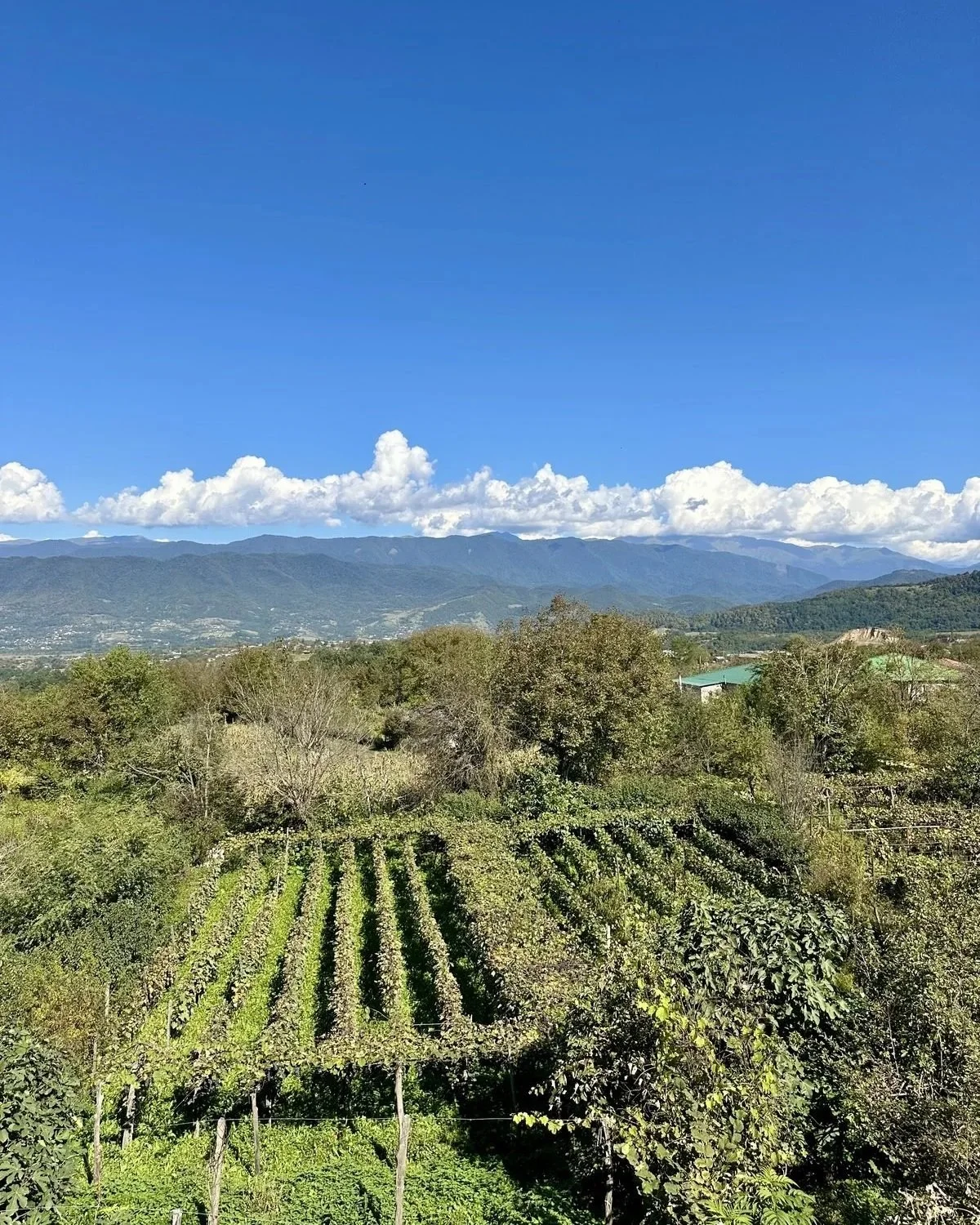
Lunch with a view at Ucha’s family winery.
We made one last stop at golden hour, at a viewpoint over Borjomi, the town famous across the former Soviet Union for its mineral water. The valley was just starting to turn with fall colors, and it was gorgeous.
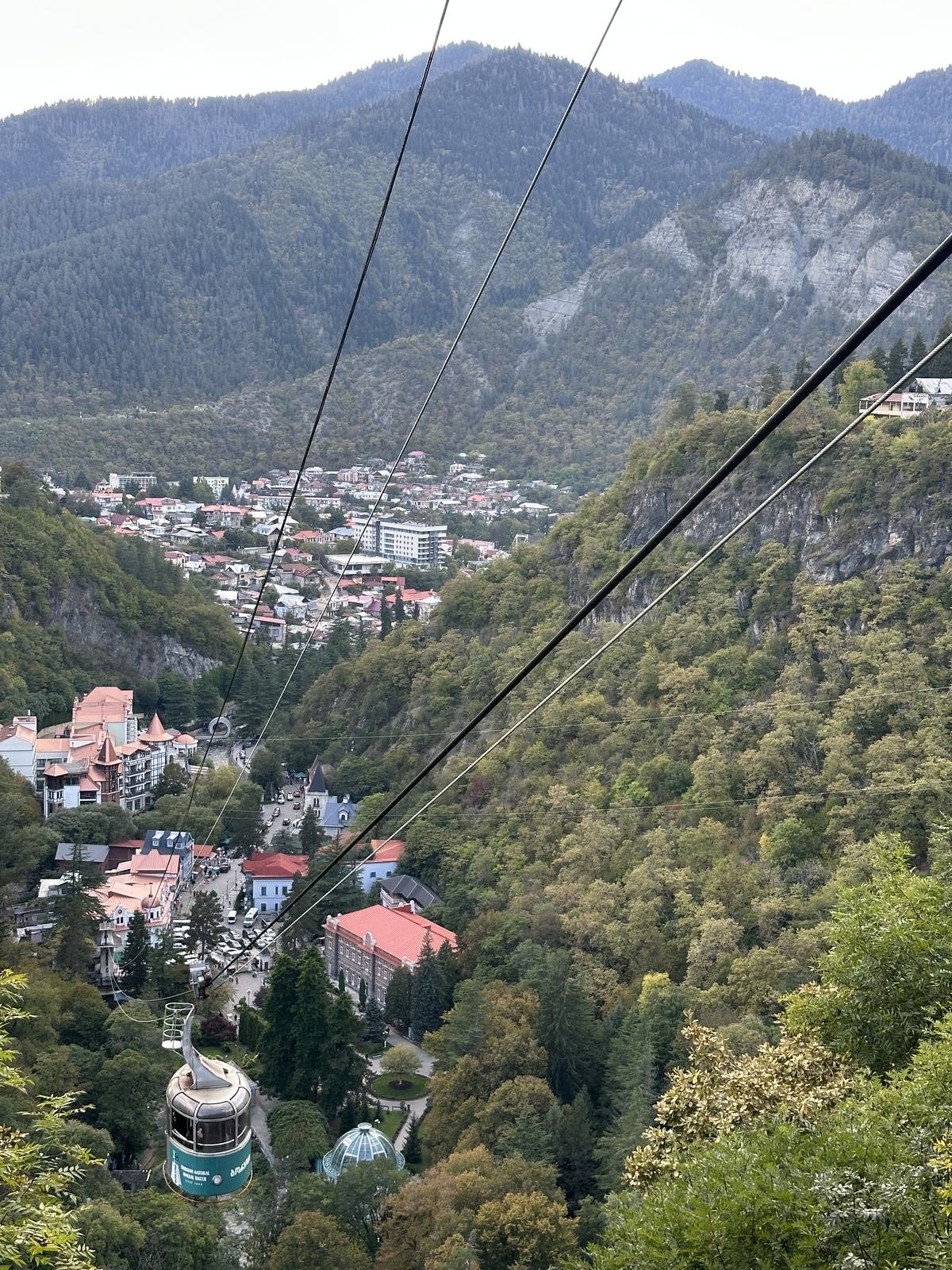
Borjomi, tucked into a valley just starting to turn for fall.
By the time we reached Rabati, it was dark—but not so dark that you couldn’t see that our hotel was actually INSIDE a medieval fortress.
The next morning, we explored Rabati Fortress, which has been rebuilt over the centuries by Georgians and Ottomans. You can see both influences in the buildings, with a church and mosque inside the same walls.
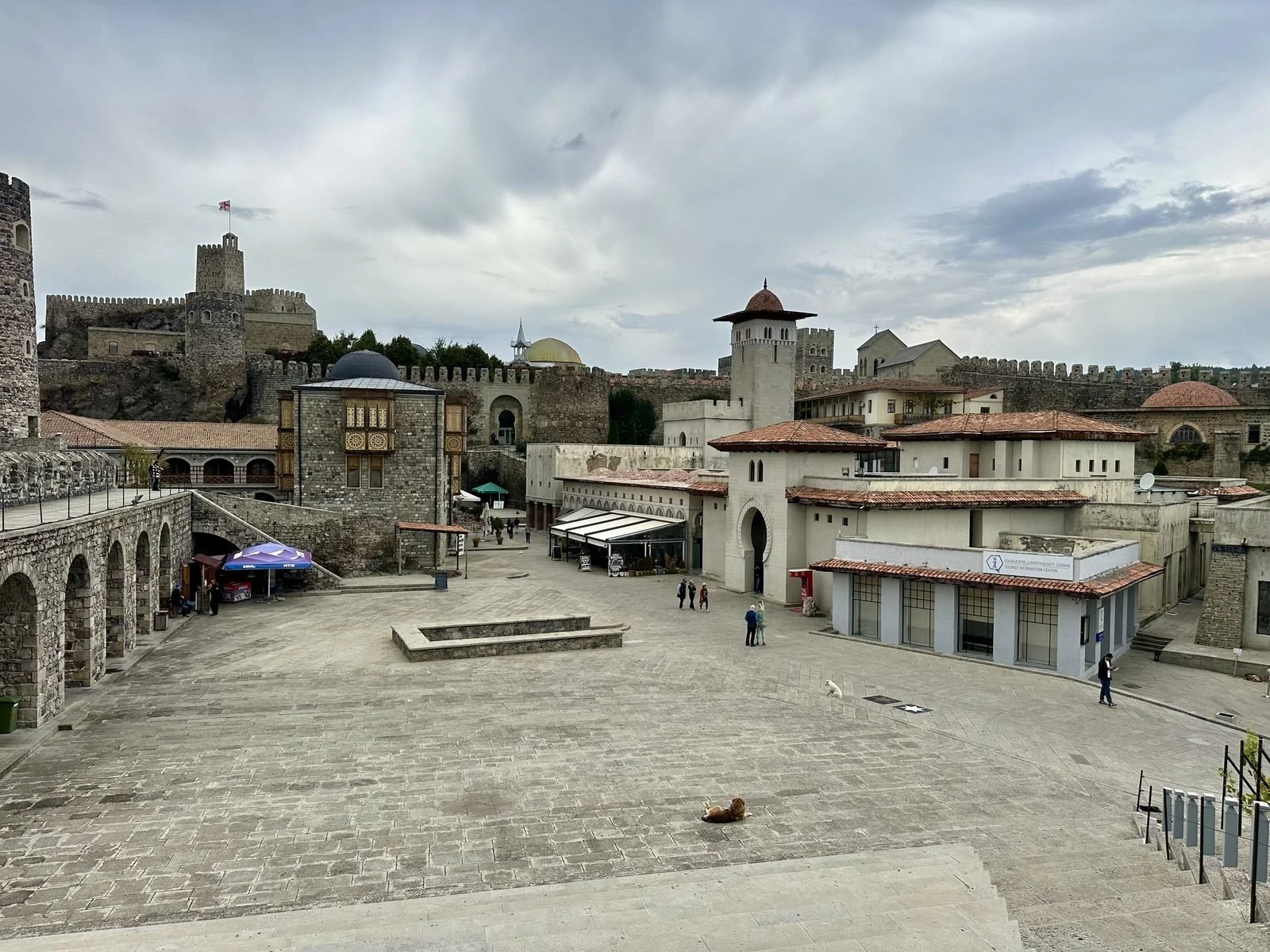
Rabati Fortress, a.k.a. the place we got to call home for two nights.
In the afternoon, we drove out to the tiny villages south of town to visit the Chobareti ethnic house, where we watched a local family make tenili, a traditional string cheese that gets pulled into incredibly thin threads by hand, and kada bread, a sweet bread filled with a streusel of flour, sugar, and butter (lots and lots of butter).
We returned to our fortress hotel for a few hours before heading out to dinner at Atskuri Winery, where a local family welcomed us into their home for a lively dinner of traditional Meskhetian dishes and their own wine. This was the most unhinged supra yet, with Giorgi breaking out his singing and guitar-playing skills and all of us getting REALLY into some Backstreet Boys and George Michael songs.
(Photographic proof of this evening only available by request.)
Back to Tbilisi, or Our Final Supra
Our last day looped back toward Tbilisi by way of the Uplistsikhe cave town, a village dance school and one final supra.
“Guys, guys,” Giorgi said. “There’s going to be a lot of food again today.”
It was our last full day in Georgia, so I wouldn’t have expected anything less.
On the way back toward Tbilisi, we stopped at Uplistsikhe, an ancient cave town carved into the rock that dates back to the Bronze Age. We wandered and climbed over the rocks through what used to be homes, temples and streets—and I learned that Birkenstocks are actually pretty good climbing shoes in a pinch.
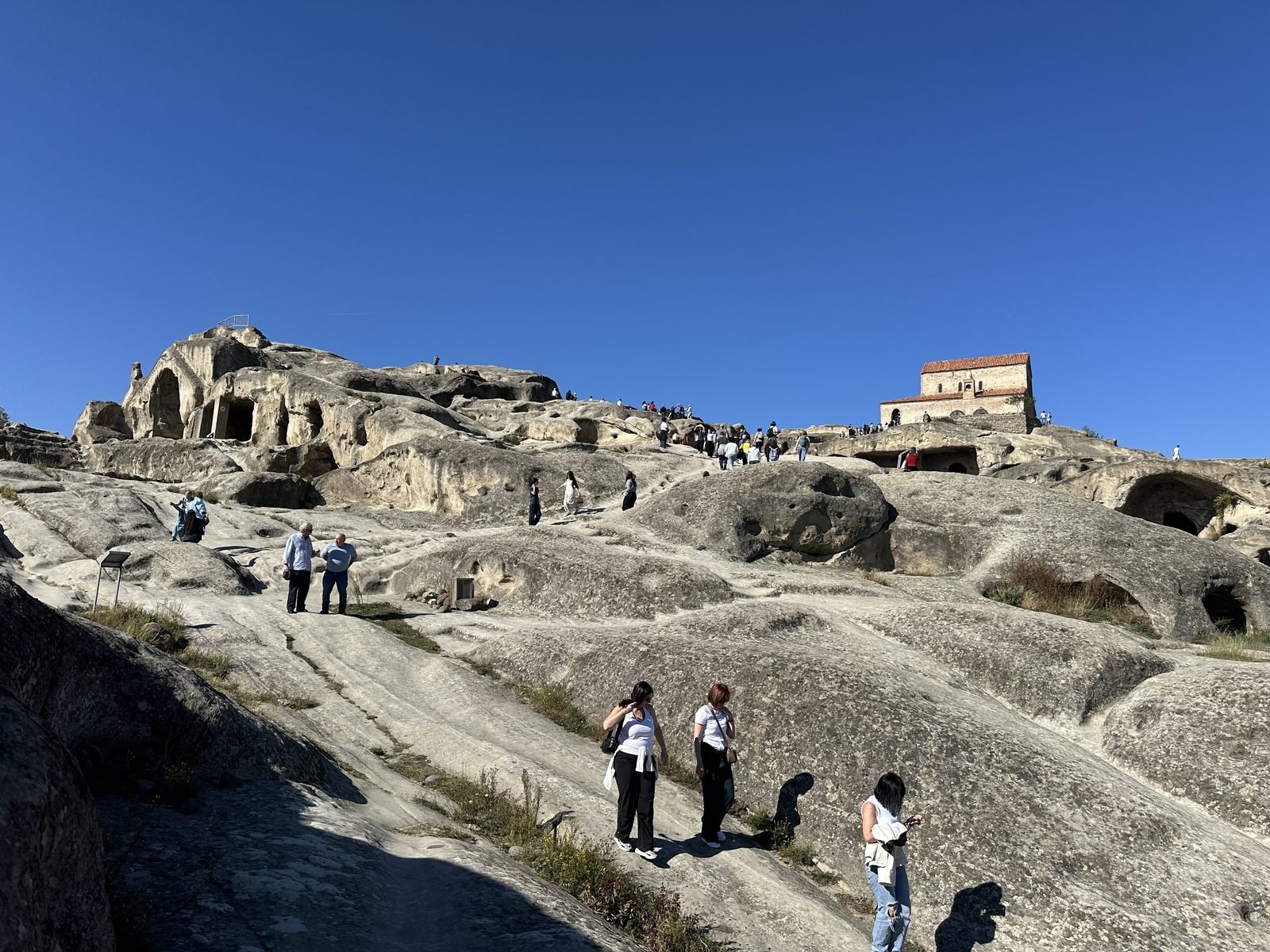
Uplistsikhe, which I can confirm is very climbable in Birkenstocks.
Then, it was on to a small village school in Khidistavi to meet a children’s dance troupe. The kids—all teenagers—performed for us, and I was honestly mesmerized at the restraint and skill it took to learn all that choreography. Their teacher, Tengo, is a former professional Georgian dancer himself, and his pride in his troupe was so beautiful to see.
From the school, we followed Tengo to his own winery, because in Georgia the dance teacher is also a winemaker. After a visit to his wine cellar, we sat down to our final supra. This one came with polyphonic singing right at the table, a traditional Georgian style where several voices weave together in harmony.
By this point, everyone in the group was feeling confident enough to try our hands at our own toasts, and from the encouragement Giorgi and Tengo were giving us, we must have been doing something right (that, or they didn’t want to hurt the feelings of their guests).
I’ve been on seven group trips with Type 2 Travel now, and the last day is always my favorite. It’s not because we’re leaving (although I do miss my own bed). It’s because by then, I get to watch people who didn’t know each other a week earlier, guides included, act like old friends. On this trip, I’d also traveled with two people from the group on other T2T trips, and it was so good to catch up with them. If we have anything to say about it, Georgia won’t be our last trip together.
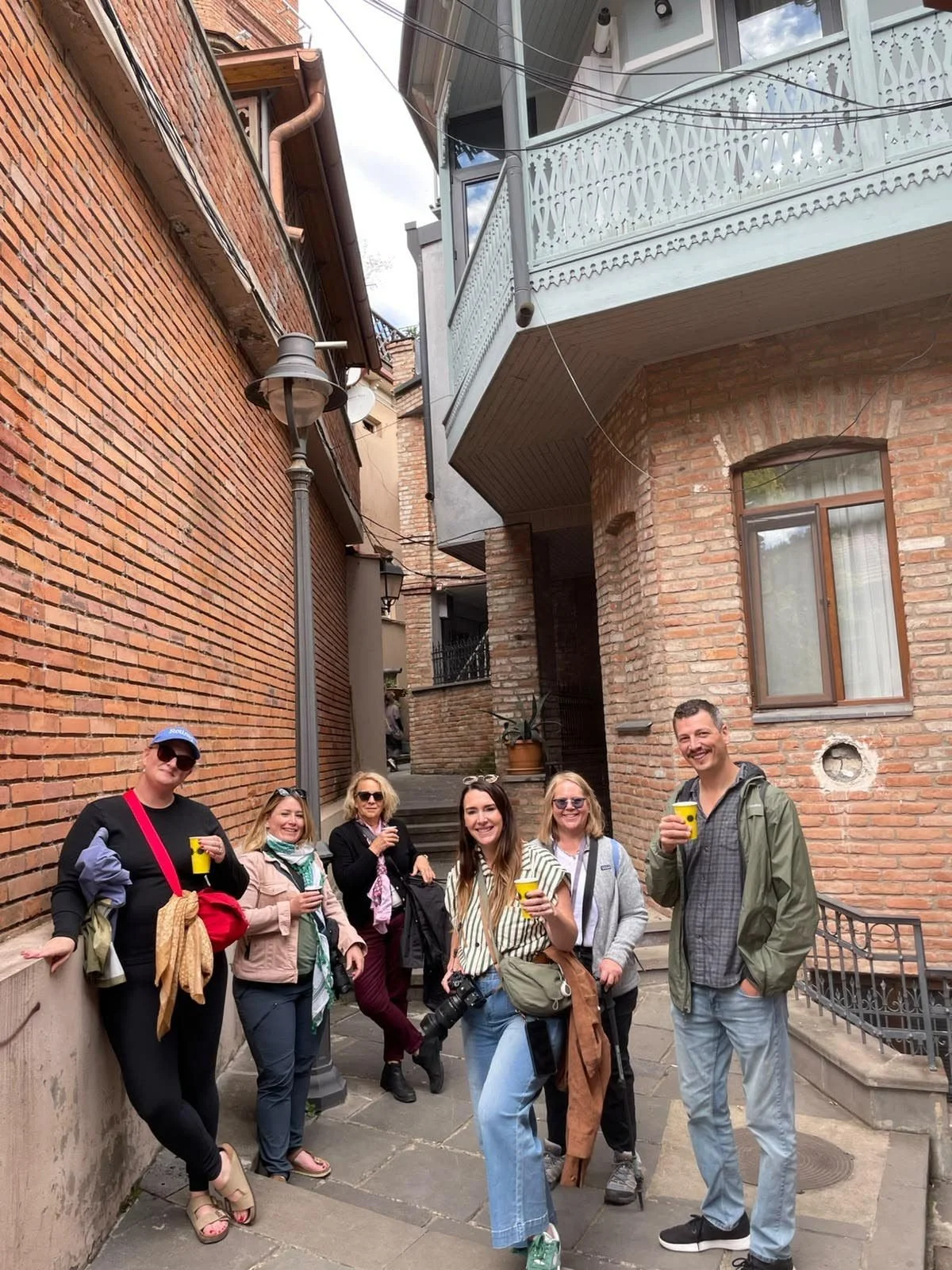
Our Georgia crew in Old Tbilisi
So, while I never wanted the first supra to end (and often wondered if it would), it’s safe to say that Georgia, with its wine, its food, its culture and most of all its people, has my heart a million percent.
I’ve been home for a few days now, and I keep waiting for a van to pull up and whisk me away to a supra with never-ending food and thirty toasts. That van hasn’t come yet, so I guess it’s grilled cheese for dinner tonight. ☺️
Want more Georgia? Read Erik’s take on his first group trip to Georgia, listen to three travelers talk wine and group travel in Georgia on the Type 2 Travel podcast, or see what Mel got up to at Camp Lola Whiskey 2026.
The Georgia Questions Everyone’s Asked Me Since I Got Home
Do you need travel insurance to visit Georgia?
Yes, and not just because Type 2 Travel requires it. As of January 1, 2026, Georgia requires every visitor to carry travel insurance for their entire stay, and you can be asked for proof when you enter the country. Type 2 Travel recommends Wanderwell, where travel medical coverage can start at around $50. Keep a copy of your policy on your phone before you land in Tbilisi.
When is grape harvest season in Georgia?
We went in early October, right in the middle of the harvest, which Georgians call rtveli. That’s why we got to pick and stomp grapes in Kakheti. October days usually run from the mid-60s to the low 70s, evenings drop into the 50s, and the sun sets around 7 p.m. Pack layers, plus something that covers your shoulders and knees for churches and monasteries.
How much moving around is there on a Georgia group trip?
It’s a road trip, so plan on moving. We stayed in five places over nine nights, and most stops were one or two nights. Everyone gets one suitcase and one backpack. Pack like you’ll be hauling it yourself, because at the fortress hotel in Rabati, the van parks about 500 feet away on cobblestone and there’s no elevator.
Do I have to drink at a Georgian supra?
No. You can have as little or as much wine as you want, and it’s basically bottomless, but nobody forces you to drink. The word you’ll hear all night is gaumarjos, which means “cheers.”
How much should you tip in Georgia?
Tipping isn’t mandatory, but leaving 5–15% at restaurants and cafés is appreciated, since most places don’t add a service charge. For guides, about $10–15 a day is a good rule of thumb, and about $5 a day for a driver.
When is the next Type 2 Travel trip to Georgia?
Type 2 Travel is going back to Georgia in October 2027, which means harvest season again. Dates aren’t set yet, but you can join the Georgia waitlist to hear about them first.